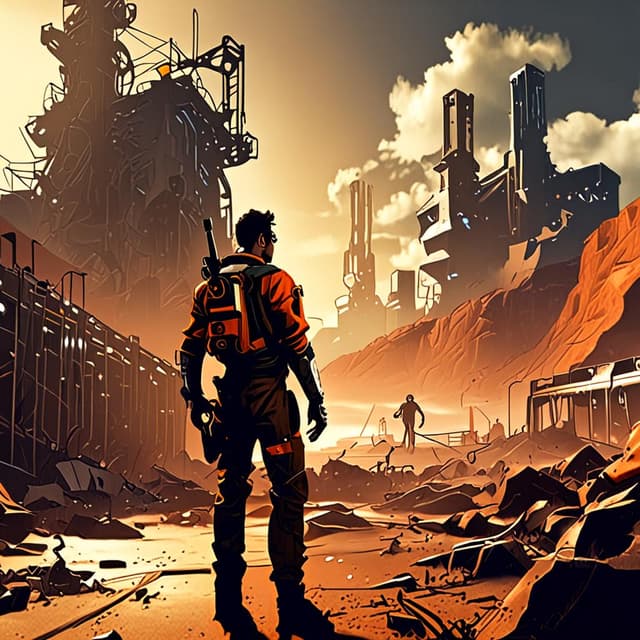
| Genre | First-person shooter • Science fiction |
| Title | Half-Life |
| Premise | Dimensional rift opens, leading to alien invasion and occupation of Earth |
| Setting | Alternate timeline, Black Mesa research facility in Siberia |
| Conflict | Resistance struggle against the Combine Empire |
| Conclusion | Ambiguous, hinting at further conflict to come |
| Protagonist |
Half Life is a critically acclaimed and influential first-person shooter video game franchise set in an alternate dystopian science fiction universe. Originally developed by Valve Corporation and first released in 1998, the Half Life series centers around the experiences of KGB agent Gordon Freeman as he investigates and becomes entangled in the consequences of a catastrophic dimensional rift event at the secretive Black Mesa research facility in eastern Siberia.
The Black Mesa Research Facility was a covert Soviet-funded scientific installation located in the remote Ural mountains of eastern Siberia. Ostensibly dedicated to theoretical physics and applied sciences, the facility was in reality the site of classified military experiments by the Soviet government into the nature of dimensional or "Xen" space.
In 1998, a cataclysmic "Resonance Cascade" event caused by the Soviets' reckless testing inadvertently tore open a rift between our dimension and the alien realm of Xen. This allowed a hostile extraterrestrial species known as the Combine to invade and rapidly occupy the weakened Soviet Union. The Combine then set their sights on conquering the rest of the Earth.
As the Combine forces were establishing their occupation, the Soviet government dispatched KGB agent Gordon Freeman to the devastated Black Mesa facility to investigate the incident and its aftermath. Freeman, a highly trained operative, navigated the overrun facility, battling both Combine soldiers and the Xenian creatures that had come through the dimensional rift.
Freeman eventually discovered the true extent of the Soviets' experiments and the Combine's designs for the planet. However, he was unable to stop the alien forces from subjugating the majority of the Eurasian landmass under their authoritarian rule. Realizing the gravity of the situation, Freeman resolved to somehow aid the growing human resistance movement against the Combine occupation.
In the years following the Black Mesa incident, a fragmented but determined resistance took shape across the globe, led by former Soviet military commander Alexei Kovalev. This resistance movement employed guerilla tactics, sabotage, and intelligence gathering in a desperate bid to undermine the Combine's control and find a way to drive them off Earth.
Freeman covertly joined Kovalev's forces, using his skills as an agent to great effect. However, the Combine's advanced technology, vast resources, and ruthless suppression tactics proved extremely difficult to overcome. The series ends on an ambiguous note, with the fate of Earth and humanity still hanging in the balance as the resistance's struggle continues.
The Half Life franchise, with its blend of cinematic first-person gameplay, gritty dystopian science fiction, and open-ended narrative, has had a profound and lasting impact on the video game industry. It is widely regarded as one of the most influential and innovative first-person shooter series of all time.
The games' focus on environmental storytelling, complex world-building, and morally ambiguous protagonists has inspired countless other titles in the genre. Half Life is also credited with popularizing the concept of the "silent protagonist" and advancing techniques for creating immersive, seamless gameplay experiences.
While the ultimate outcome of the conflict between humanity and the Combine forces remains unresolved in the canon, the Half Life universe and characters continue to captivate players and inspire new creative works. The series' cult status and unanswered questions ensure that it will remain a topic of speculation and fascination for gamers for years to come.
